

Why does hair loss at the temples matter?
Restoring hair loss at the temples is one of the most complex procedures in modern hair transplantation. Patients often lose hair at the temples first, which significantly affects facial harmony. Restoring this area is therefore decisive for achieving a balanced, youthful appearance.
So why is restoring the temples so important? Because the temples define the structure of the face. Even a slight recession creates the impression of ageing or advanced hair loss.
At Clinique de Monsieur, our goal is to deliver aesthetically flawless results with precision. With innovative methods such as Direct FUE, the grafts are placed using the Choi implanter, allowing precise placement, minimal trauma and a natural result.
What Causes Temple Hair Loss?
Why do the temples recede first?
First, the main cause of recession at the temples is androgenetic alopecia. In addition, the follicles in this area are particularly sensitive to hormonal changes (DHT), so they are affected more quickly.
What other factors contribute to temple hair loss?
Many factors affect hair loss at the temples. They include:
- hereditary tendency
- sensitivity to DHT
- age
- lifestyle and environmental factors
Why is temple hair loss so noticeable?
Because the temples define the outline of the face, even a small loss can significantly affect its balance. As a result, many patients look for solutions early.

Who is suitable for temple restoration?
When should I think about temple restoration?
If you notice that your temples have receded to a degree that affects the shape of your hairline or the symmetry of your face, you may need to consider restoration. In addition, once hair loss has stabilised, the chances of long-lasting natural results increase.
Can younger patients be good candidates for temple restoration?
Younger patients can be suitable candidates. However, careful planning is required so that the result remains natural in the future.
Why is a personalised consultation essential?
A personalised assessment ensures that the treatment suits the shape of your face, the density of your hair and the progression of hair loss. It is therefore a key element for excellent results.
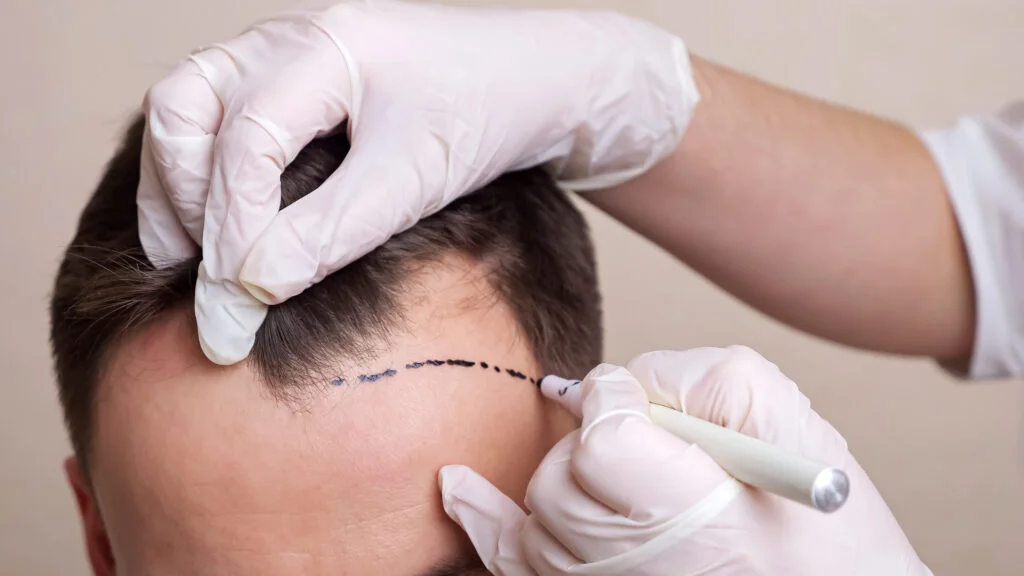
How Is Temple Hair Restoration Done?
Why is it demanding from an aesthetic point of view?
Hair at the temples grows at very specific angles and directions. Achieving a natural result therefore requires high precision. Even small mistakes can lead to an unnatural result.
How is it performed with Direct FUE?
Restoration is performed with Direct FUE, where the grafts are placed using the Choi implanter. This method offers complete control over angle, depth and direction.
Step-by-step procedure
The stages include:
- extraction of healthy follicles from the donor area
- design of the temple zone according to facial proportions
- the grafts are placed precisely using the Choi implanter
- blending the grafts with the existing hair
Why is precision essential?
Because the area is so visible, precision directly affects how natural the result is. Experience and technique are therefore of decisive importance.
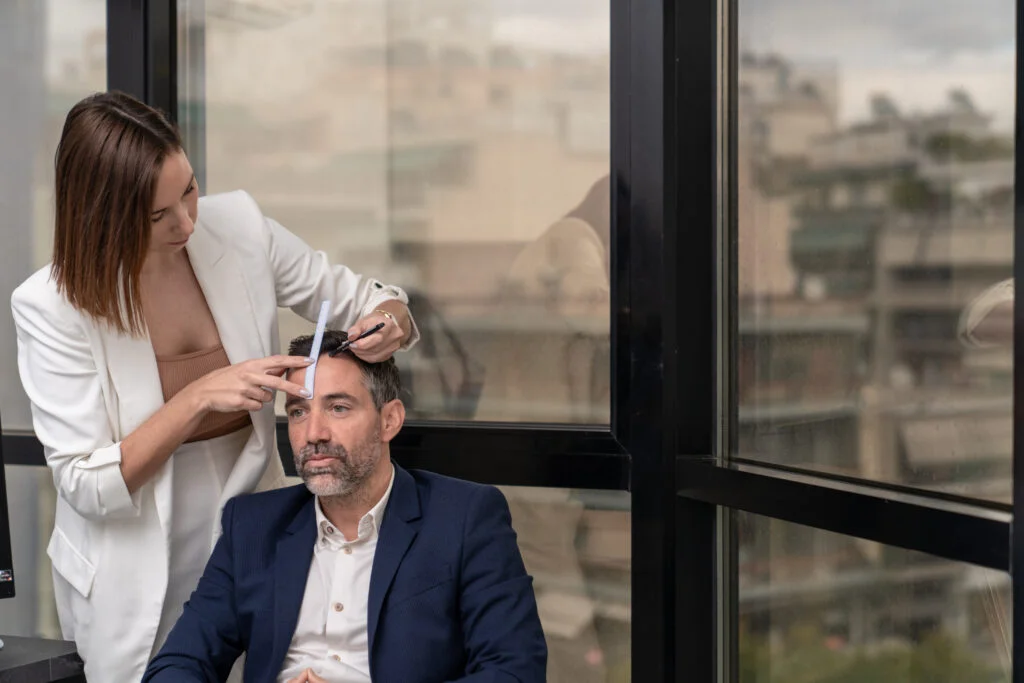
Benefits of Direct FUE in Temple Restoration
Why choose Direct FUE?
Direct FUE is a minimally invasive and highly precise technique. That is why it is an ideal choice for sensitive areas such as the temples.
How does the Choi implanter improve the results?
Because the grafts are placed using the Choi implanter:
- precise direction is achieved
- trauma to the tissue is reduced
- recovery is faster
What are the benefits for patients?
The benefits include:
- faster recovery
- less pain
- higher graft survival
- a more natural hairline
Direct FUE therefore improves both recovery and the final result.
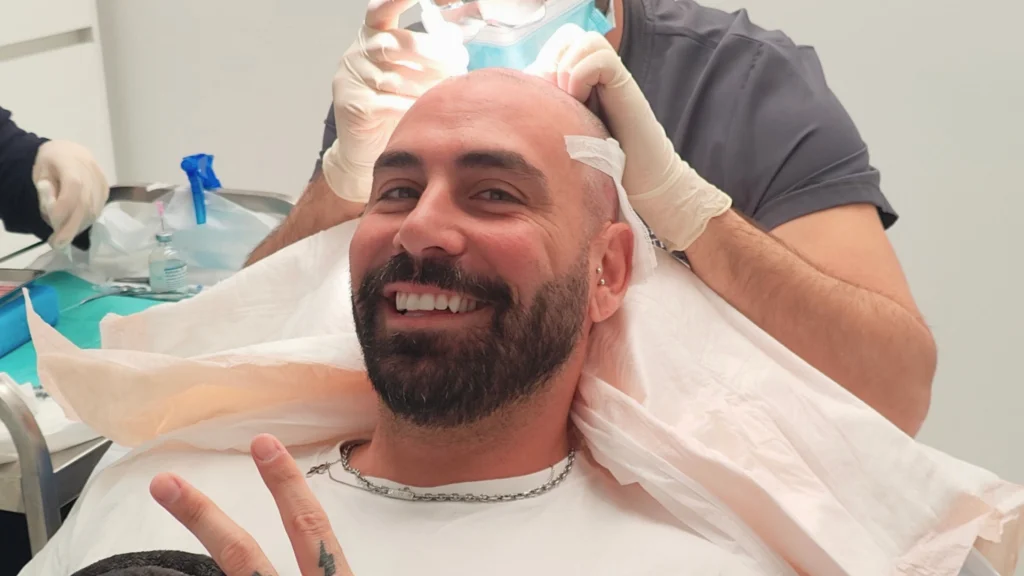
Recovery after temple restoration
What happens immediately after the procedure?
After the procedure, patients may experience redness, slight swelling and small scabs. These symptoms are temporary.
Recovery timeline
The stages are:
- First week: initial healing.
- Two weeks: visible improvement.
- One month: the scalp stabilises.
When will new growth begin?
Growth follows a specific pattern:
- At 2 to 4 weeks, shedding begins.
- At 3 to 4 months, new growth begins.
- At 9 to 12 months, the final results appear.
Looking for a Natural Solution to Restore Your Temples?
At Clinique De Monsieur, every case is assessed individually, with the goal of achieving a harmonious and natural-looking result that complements your unique facial features.
Contact us today for a personalised consultation and find out whether temple hair restoration with Direct FUE is the right option for you.