
Hair Transplant Techniques
In AthensChoosing the right transplant technique is a purely medical decision that directly affects the final result and the long-term health of the donor area. A wrong choice or poor execution can lead to an unnatural result, low graft survival or even irreversible damage to the donor area, limiting future corrective options.
For this reason, it is important to understand the differences between FUT, FUE and Direct FUE before going ahead.

The Basic Principle of Hair Transplantation
All techniques are based on the same principle: extracting hair follicles from a donor area that is resistant to hair loss (usually the lower back of the head) and placing them in areas of thinning or baldness. The procedure involves two critical stages: extracting the follicular units and implanting them in the recipient area. The technique used at each stage affects: the level of scarring, the density, the graft survival rate and how natural the final result looks.
FUT (Follicular Unit Transplantation)
FUT (Follicular Unit Transplantation)
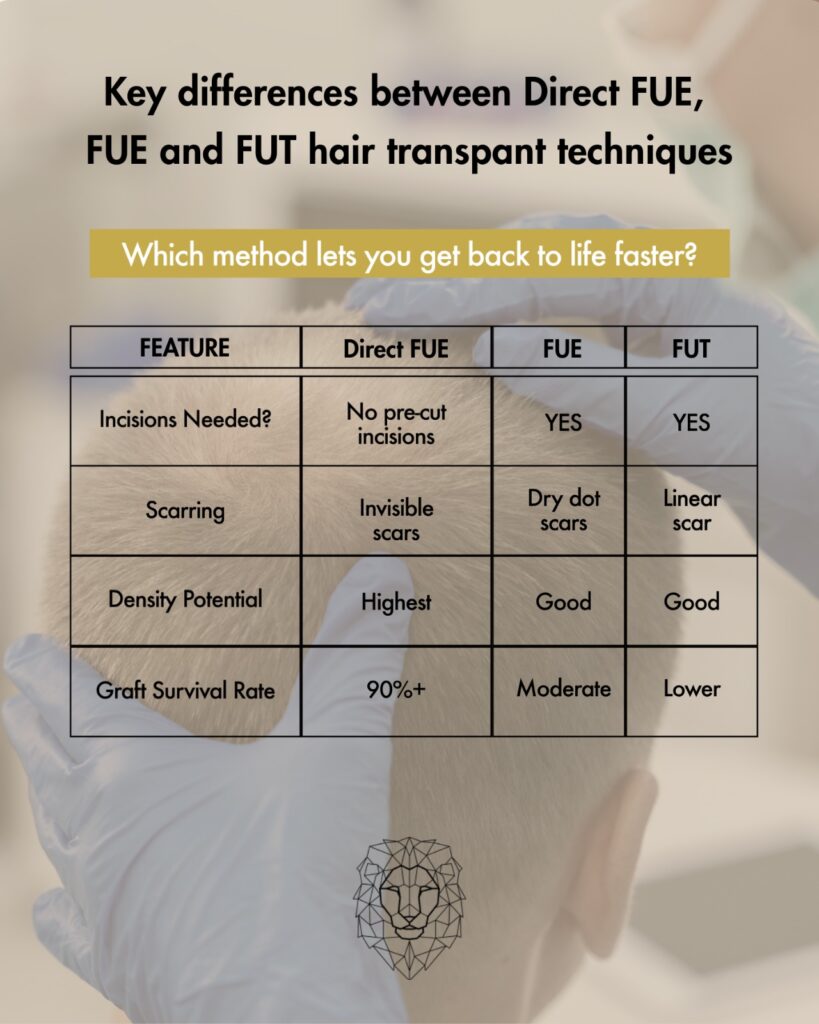
FUT is a traditional method in which a thin strip of skin is surgically removed from the donor area. The follicles are then separated under a microscope into individual units and the area is stitched.
Characteristics of FUT:
- Faster extraction phase
- A linear scar in the donor area
- The scar can be visible with short haircuts
- Not suitable for people prone to keloid scarring
Although it may be more affordable because it is faster, it leaves a permanent linear scar and is now chosen less often by men who prefer very short haircuts.
FUE (Follicular Unit Extraction)
FUE (Follicular Unit Extraction)
In FUE, the follicles are extracted individually without removing a strip of skin. Scarring is diffuse and microscopic, with no linear scar.
However, in conventional FUE:
- The grafts are removed first
- They are kept outside the body temporarily
- They are implanted at a second stage
The increased handling and time outside the body can affect their survival.
Direct FUE (Advanced Direct Hair Implantation)
Direct FUE (Advanced Direct Hair Implantation)
Direct FUE is an evolution of FUE. Each graft is implanted immediately after extraction, without prolonged storage.
Using a Choi Implanter, the doctor has complete control over:
- Angle
- Depth
- Direction
- Density
This offers:
- Minimal trauma to the grafts
- A higher survival rate
- A more natural hairline
- Faster healing
FUT vs FUE vs Direct FUE — Key Differences
Why Technique Selection Matters
A transplant is not only about the number of grafts.
Long-term success depends on:
- Preserving the donor area
- The graft survival rate
- Correct hairline design
- Precise control of implantation
- Planning based on the future progression of hair loss
Choosing the right technique and medical team significantly reduces the risk of an unnatural result or future corrective surgery.
Frequently Asked Questions
Which technique is best?
The most suitable technique depends on donor capacity, the hair loss pattern and long-term planning. Direct FUE offers the greatest control over implantation.
Does Direct FUE leave scars?
It does not create a linear scar. The marks are microscopic and usually not visible.
Is FUT still recommended?
It may be indicated in specific cases, but it is chosen less often because of the permanent linear scar.
Is Direct FUE more natural?
Yes, thanks to complete control over the angle, depth and direction of implantation.
Book a hair loss diagnosis
The correct technique can only be determined after a complete medical evaluation.
At Clinique de Monsieur, all procedures are planned and performed according to strict medical guidelines in a private, men-only environment.
Our doctors will assess your case and recommend the method that preserves the donor area and delivers a balanced, natural result with a long-term perspective.