

Introduction
Hair transplant for men: What really is the right age for men to have a hair transplant? Is it advisable at 25, at 30 or after 40? Many men start to notice hair loss very early and look for a permanent solution. Yet the success of a transplant does not depend on technique alone. Instead, it depends mainly on the ideal timing, an accurate diagnosis and a restoration strategy for the future. This guide looks at the right age for a hair transplant, identifying when it is too early or too late. We analyse the factors that can affect the result and offer guidance so you can make the right decision. We also answer important questions that many men have before going ahead with the procedure.
At What Age Is a Hair Transplant Possible?
Can a hair transplant be done before 25?
Technically, the hair transplant procedure can be carried out from the age of 18. But is it appropriate to make such a decision at this early age? In most cases, no. That is because androgenetic alopecia has not yet stabilised. As a result, the future course of hair loss remains uncertain.
In addition, if hair loss continues, asymmetry can appear or a second transplant may become necessary. For this reason, specialists often recommend waiting until there is a clearer picture of progression.
What are the risks of a very early transplant?
Let’s look at the likely consequences of proceeding too early:
• Hair loss may continue behind the new hairline
• An unnatural aesthetic result may occur
• The donor area may be used up prematurely
• The likelihood of needing a second procedure increases
That is why choosing the right timing helps secure the best possible outcome.
What Is the Best Age for a Hair Transplant in Men?
Is 30 the most suitable age for a hair transplant?
Usually, yes. Most specialists consider the best age range for hair transplantation to be between 30 and 45. By that time, the progression of hair loss is typically clearer, which allows for a natural hairline design and a result that lasts.
Why does this age range often produce better results?
• Androgenetic alopecia has reached a stable stage
• The donor area has been properly assessed
• The planning is based on the expected future progression of the condition
• The final result looks more natural and keeps its lasting value
This creates the right balance between aesthetics and long-term sustainability.

Which parameters show whether you are ready for a transplant
Age matters, but it is not the only factor. A responsible decision requires multiple criteria.
Has hair loss stabilised
If hair loss remains aggressive, the result may not stay stable long-term. That is why stability is assessed before the final decision.
Quality of the donor area
Success depends on donor density, hair quality, skin elasticity, and graft availability. Without a strong donor area, the final result may be limited.
What is the stage of androgenetic alopecia
We use the Norwood scale to understand the level of hair loss, its future progression and the right strategy. An accurate diagnosis is therefore an essential requirement before any treatment.

Hair Transplantation in Younger Men and When It Can Be Appropriate
Is a hair transplant possible at age 25?
Yes, but only under specific conditions: when hair loss has stabilized, when there is significant psychological burden, when a conservative hairline design is applied, and when there is a long-term restoration plan. Even then, it requires experience and strategic planning.
A different approach is required for younger patients
For younger patients, we prioritize donor preservation, a naturally evolving hairline, and the option of a second session later. This is how we secure a sustainable, natural result.
Is There an Age Limit for Hair Transplantation?
Is a hair transplant possible after 50?
Yes. Age alone is not a limiting factor. Many men over 50 achieve excellent results when the appropriate medical criteria are met.
What we evaluate in older patients
We examine general health, the quality of the donor area, medical history and realistic expectations.
Why Personalized Diagnosis Matters More Than Age
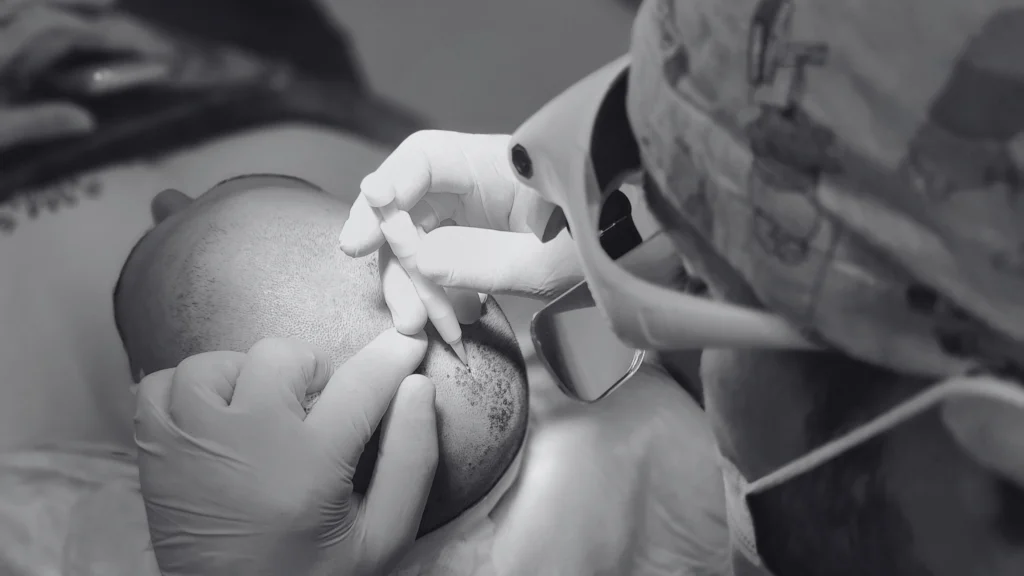
A successful hair transplant does not depend only on age. It requires a complete, in-depth evaluation.
What a proper diagnosis includes
• Detailed trichoscopy
• Examination of the donor area
• Planning for future progression
• Medical guidance
• Long-term strategy
Conclusion
There is no single universal answer for the right age for a hair transplant in men. Ages 30 to 45 are often the most suitable, but the final decision depends on hair-loss stability, donor quality, and correct planning. Hair transplantation is a medical procedure that requires expertise, strategy, and a personalized approach. Proper diagnosis leads to better long-term results and a more natural restoration.