

Introduction
Natural hairline: why is it so important in hair restoration?
When restoring the hairline, a natural result is undoubtedly the most important factor that determines the final aesthetic outcome. Whether you are younger or older, and whether you have thinning on top or a receding hairline at the front, your hairline defines the balance of your face and significantly affects your overall appearance. Understanding how a natural hairline is created is therefore just as important as the transplant procedure itself.
At Clinique de Monsieur, we focus on precision, personalisation and long-lasting aesthetic results. By using modern techniques such as Direct FUE, where the grafts are placed using the Choi implanter, we achieve ideal density, correct direction and complete naturalness.

Analysing the structure of a natural hairline
What does a truly natural hairline look like?
A natural hairline is not perfectly straight. Instead, it includes small imperfections that mimic natural hair growth. This creates a soft, balanced result that looks completely natural.
What are the key characteristics of a male hairline?
- A slightly irregular shape
- A gradual increase in density towards the inside of the head
- A softer line at the central front point
- Harmony with the facial features
Why does asymmetry lead to a more natural result?
The human brain easily recognises patterns. A perfectly straight hairline looks artificial. In contrast, small controlled imperfections create a more natural and realistic result.
Determining the position of the hairline based on facial features
How do doctors decide where to place the hairline?
Placement is based on the proportions of the face. That is why specialists assess each patient individually before designing the hairline.
Which factors affect the position?
- Forehead length
- Facial symmetry
- Age
- Future progression of hair loss
Why is proper placement so important?
A low hairline can look unnatural over time. On the other hand, a hairline that is too high may not deliver the desired result. The right balance is the key to a timeless result.

Gradual increase in density for a natural result
Should there be high density at the front?
Although many patients ask for high density at the front, naturalness is achieved through a gradual distribution of density.
How is density distributed?
- Lower density at the front
- Increasing density in the middle
- Higher density towards the back
Why should it not be the same everywhere?
Natural hair does not have uniform density. Variation creates a more realistic result and better blending with the existing hair.
Angle and direction of hair growth
Why are angle and direction important?
Hair grows at different angles depending on the area of the head. Reproducing these patterns is essential for a natural result.
How is precision achieved in these areas?
With the Direct FUE technique, where the grafts are placed using the Choi implanter, doctors control:
- Angle
- Depth
- Direction
What ensures natural placement?
Placing the grafts with the Choi implanter allows complete control, so the hair grows naturally.
Why is Direct FUE decisive for a natural result?
Why is Direct FUE preferred?
Direct FUE is a minimally invasive method that offers high precision and fast recovery.
What are the advantages?
- Less trauma to the skin
- Faster healing
- A high graft survival rate
- Absolute control of placement
How does it improve the result?
Because the grafts are placed using the Choi implanter, natural direction and density are achieved, creating an undetectable result.
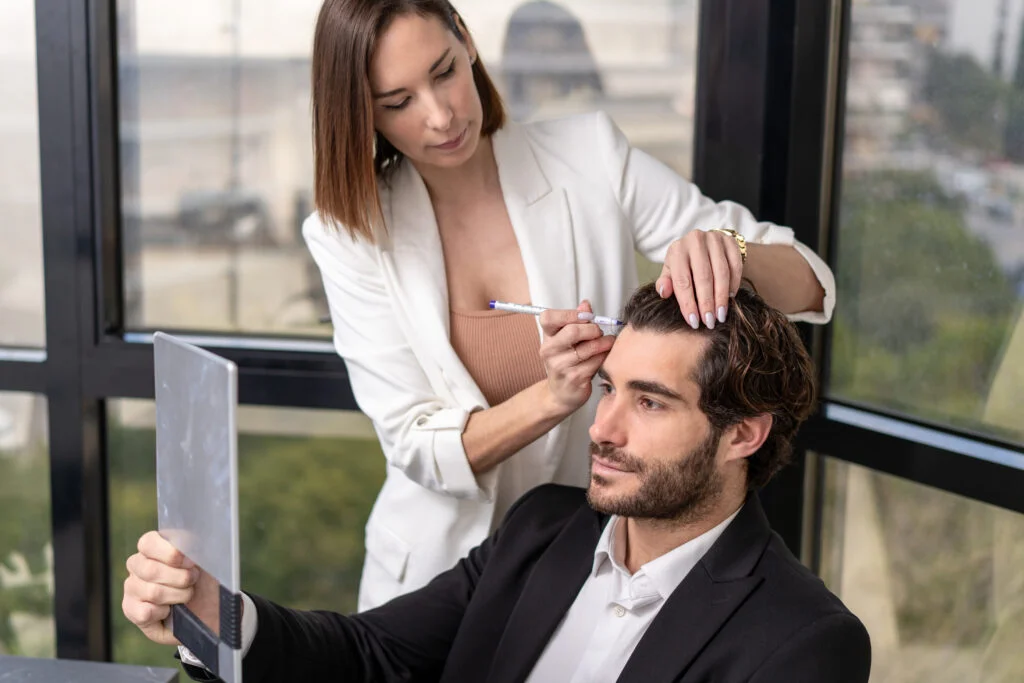
Personalising the hairline
Does everyone have the same hairline?
No. Every patient has different characteristics, so personalisation is required.
What is tailored?
- Hairline shape
- Density distribution
- Placement strategy
- Long-term planning
Why is personalisation important?
Personalisation ensures a natural, aesthetically flawless result.
Common mistakes in hairline design
What are the most common mistakes?
- A hairline that is too straight
- Placing the hairline too low
- Excessive density in the frontal area
- Incorrect direction of growing hair
Why do these missteps occur?
Because of older techniques or a lack of experience.
How can they be avoided?
By choosing specialised doctors and modern techniques such as Direct FUE.
How the result develops after the transplant
Does the hairline change over time?
Yes, because hair follows natural growth cycles.
What is the typical timeline?
- Month 1: recovery
- Months 2 to 3: resting phase
- Months 3 to 4: initial growth
- Months 6 to 12: full result
Why is patience necessary?
Gradual growth leads to more stable and natural results.
How do you recognise a successful result?
What characterises a natural result?
- Natural blending with the existing hair
- Correct direction
- Balanced density
- Harmony with the face
What indicates high quality?
Consistency of results across many patients.
Conclusion
What should you remember about designing a natural hairline?
Creating a natural male hairline requires precision, experience and aesthetic sense. It is not a standardised procedure; it requires careful planning and a personalised approach.
At Clinique de Monsieur, we combine cutting-edge technology with medical expertise. Through the Direct FUE technique, where the grafts are placed using the Choi implanter, we ensure natural growth, ideal density and long-lasting results.
Why is choosing the right clinic essential?
Because the design determines the final result. Choosing a clinic that focuses on precision and personalisation is therefore decisive.
How can you achieve the best possible outcome?
By working with specialised doctors and following a personalised treatment plan.
Are you ready to design your natural hairline?
Book your appointment today and get a personalised treatment plan with Clinique De Monsieur.