

Why does the hairline “give away” a transplant?
Have you seen a result that looks good from a distance but strange up close? The cause is often the hairline. It is the first area the eye “reads”, and every flaw shows in natural light, with a flash and on video.
That is why we aim for a hairline that looks natural even from 30 centimetres away. That is where credibility and a truly high-quality result are judged.

Which factors define a correct hairline?
The design is not based on a ready-made template. It relies on personalisation and a clinical assessment before every decision.
We take into account:
- Age and aesthetic goal, so that the result looks youthful but not boyish
- The shape of the face and forehead
- Hair type (diameter, wave, colour)
- Assessment androgenetic alopecia
- The likely progression of hair loss and the overall restoration plan
Basic design principles that stand the test of time
Should the hairline be low?
It is natural to want the hairline to “come down” so that the forehead looks smaller. However, an overly low hairline rarely stays right in the long term.
In addition:
- It requires more follicles (grafts).
- It puts more strain on the donor area.
- It creates a problem if alopecia progresses.
That is why we choose a height that suits your age and remains realistic over time. This way you gain timeless aesthetics, not short-lived enthusiasm.
Symmetry or natural imperfections?
A perfectly straight line looks artificial. Nature creates small asymmetries. That is why we build in controlled micro-irregularities, small “breaks” along the perimeter, so that the result looks authentic.
This detail keeps the hairline light and elegant, without weighing down the face.
How will it look natural over time?
Correct design is based on:
- Predictable maturing of the hairline
- A conservative height
- A rational distribution of grafts
This maintains balance and protects the donor area at every stage of life.
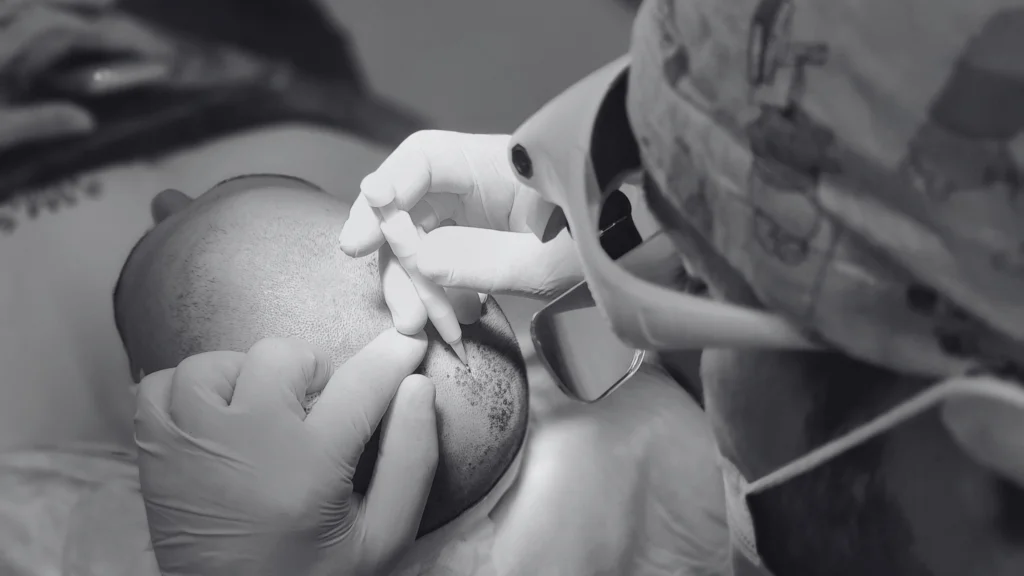
The male hairline and masculine aesthetics
What characterises a male hairline?
A male hairline:
- Has slight angles
- Keeps a natural M shape when it suits the face
- Leaves a realistic recession at the temples
This keeps the face dynamic and looking natural and authentic.
What is the most common aesthetic mistake?
A “teenage” hairline on a man over 35 is a classic warning sign.
It may look dense, but it looks unnatural. That is why we prefer a mature hairline. A mature hairline is right today and right tomorrow, and it protects the donor area from excessive use of grafts.
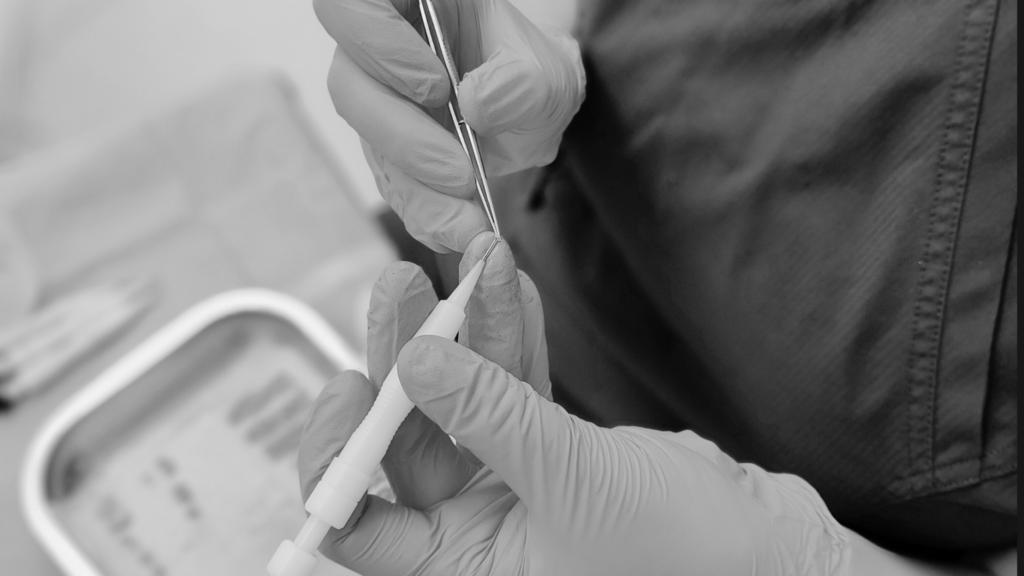
Facial mapping and proportions
How is the hairline designed for your face?
We carry out facial mapping and work with proportions.
We assess:
- Forehead height
- Eyebrow position
- Curvature of the skull
- Intensity at the temples
We then define:
- The central frontal point
- The curve and outward flow
- Temple peaks with a masculine logic
- A transition zone for a natural outline
Personalisation avoids a mass-produced result and reduces the risk of over-correction.
Transition zone and density: the detail that makes the result invisible
What is the transition zone?
It is the first rows of the hairline, where density needs to be soft rather than solid.
This is mainly where single-hair grafts are placed, to “break up” the outline and mimic natural growth.
How much density is right?
We do not aim for excessive density in the first row. We build a gradual increase in density (density gradient):
- At the front: softness and natural transparency
- Further back: a gradual increase with two- and three-hair grafts
- Even further back: visual volume and even integration
This achieves a natural result and better management of the follicles.
Donor area and graft survival
Why is the donor area your “capital”?
The donor area is limited. Every follicular unit has value.
If it is used up on an overly ambitious hairline, there will not be enough resources for the mid-scalp or crown in the future.
That is why we work carefully with the donor area. First we protect it, then we improve the aesthetics. We also keep extraction even, to avoid a thin-looking donor area.
How is follicle survival increased?
Survival depends on details, handling and discipline. We prioritise:
- Atraumatic extraction
- The right choice of instrument diameter
- Minimal time outside the body
- Proper hydration and storage
- Precise opening of the sites at the correct depth
- Gentle placement without pressure
This reduces the risk of uneven growth.
Hair angles and direction: why the direction of the hair changes everything
Hairs can “stick out”, point in the opposite direction or create a harsh outline even when the density is good.
How Do We Create Natural Movement?
- We place the grafts at small, natural angles.
- At the temples we use flatter angles.
- We follow the natural direction of the existing hair.
This ensures natural movement and easy styling.
Common mistakes in male hairline design and how to prevent them
Costly mistakes
- An overly low hairline
- A perfectly straight perimeter
- Heavy multi-hair grafts at the front
- Overly filled temples
- A lack of long-term planning
How do we prevent them?
With proper planning and answers to critical questions:
- How many grafts are needed?
- What will happen if alopecia progresses?
- How safe is the donor area?
Results timeline
The hairline goes through phases:
- Healing
- Possible temporary shedding
- Gradual growth
We do not assess the result at 6 weeks.
A clear picture is available at 6 months.
A mature result is expected at around 12 months.
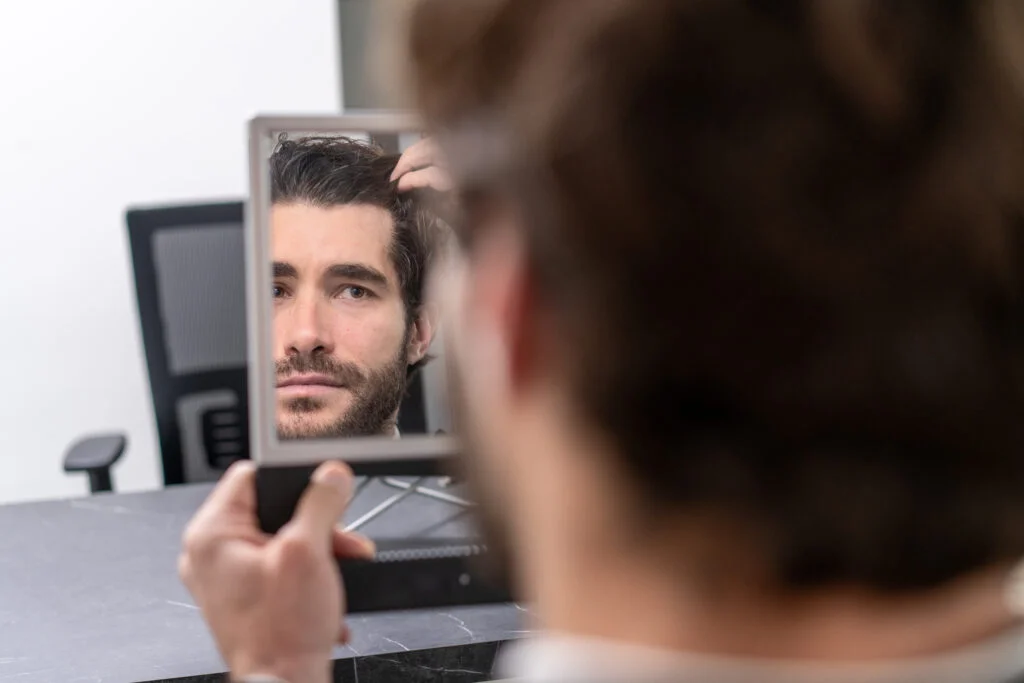
Conclusion
The male hairline is the “signature” of a hair transplant.
When it is designed correctly:
- It looks natural
- It stands the test of time
- It does not give away the procedure
If it is designed incorrectly:
- Naturalness is lost
- The donor area is used up needlessly
The right approach is based on:
facial mapping, a correct transition zone, natural angles, protection of the donor area and high graft survival. If you want a hairline that truly belongs to you, the result starts with the right design. At Clinique de Monsieur, every case is assessed using medical criteria, aiming for a natural, harmonious and timeless result fully tailored to each man's features and needs.
Interested in a hair transplant in Athens? Send photos for a free assessment by a specialised doctor.