

A long-term strategy for treating male hair loss means that hair loss management should not be treated as a single move, but as a steady, long-term plan. Because male hair loss progresses over time, effective treatment requires a proper assessment, realistic planning and consistency.
Once hair loss begins, DHT causes miniaturisation of the follicles in genetically sensitive areas, leading to reduced volume, length and visibility of the hair, until growth eventually slows down or even stops.
As a result, many men experience hair loss in the form of:
• A receding hairline
• Thinning at the temples
• A widening crown
• Diffuse thinning on the top of the head
The purpose of a long-term strategy is to create a plan that allows you to:
• Maximise your current hair growth
• Protect the donor area at the back and sides of the head
• Maintain a natural appearance for years to come
An essential starting point is understanding the pathophysiology of male pattern alopecia.
Identify your hair loss pattern before choosing treatment solutions
Which area of the head shows the greatest loss?
Start with the zone that most affects your overall appearance. A receding hairline creates the frame of the face and is usually the first visible sign of hair loss captured in photos by friends and relatives.
Loss at the crown may progress more slowly and take longer to treat, because of its whorl pattern and the way it reflects light.
Compare monthly photos taken under the same lighting conditions and from the same angles, to get an objective picture of your hair loss. Review the photos every three months to avoid rushed decisions.
Use a staging system to ensure realistic planning
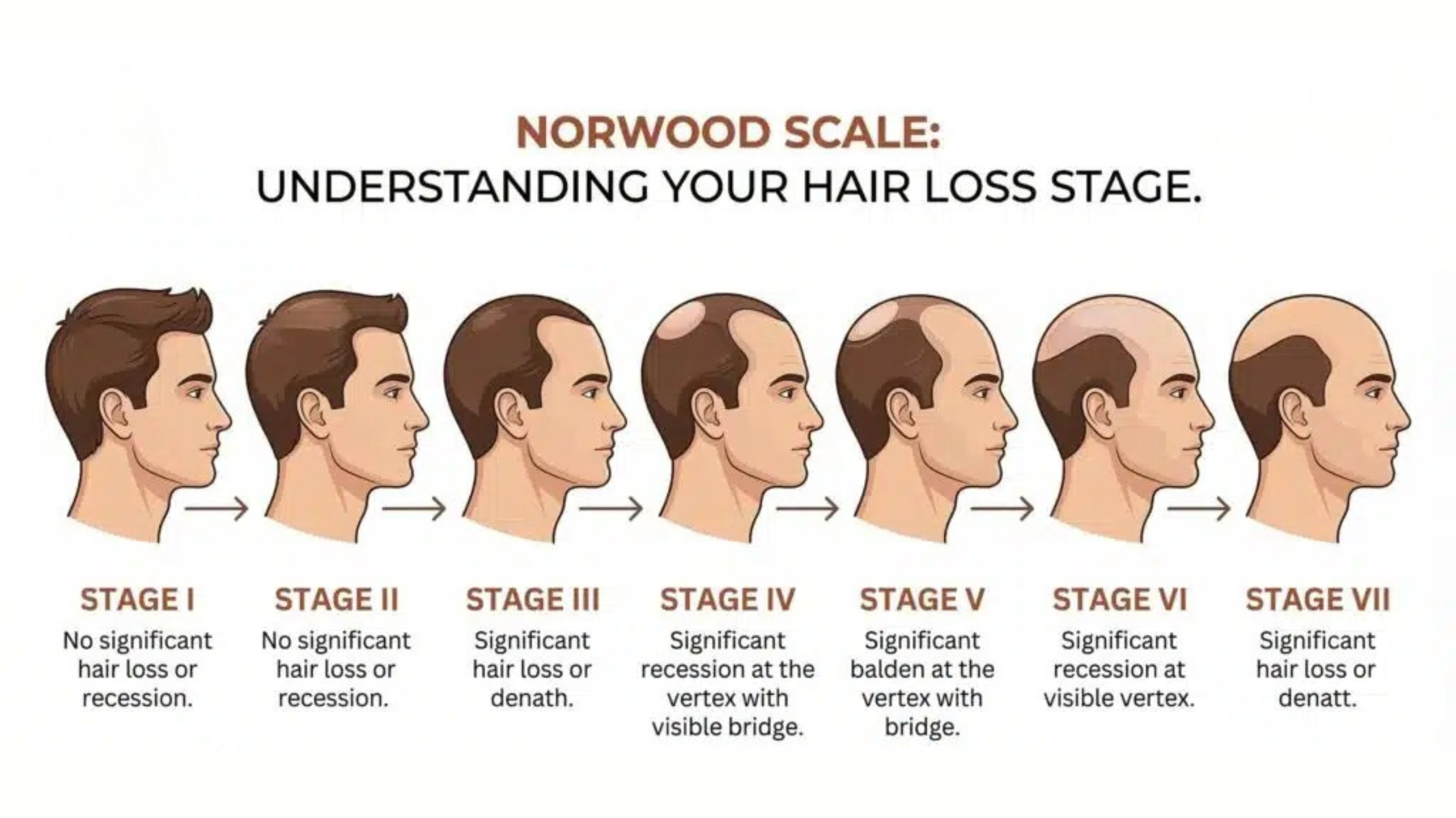
Using a common terminology makes it easier to create a plan. The Norwood Scale is one of the most widely used systems for categorising the patterns and severity levels of male hair loss. Using the scale can also help you spot an unnaturally low, straight hairline, which may look artificial as hair loss progresses.
Set long-term, measurable criteria for success
What do you want to achieve in the next twelve months?
Many men focus on preventing hair loss and regrowth. However, stabilising existing hair loss may be the most important first step in protecting what remains.
Define your success through measurable results, such as:
• Less hair loss per month
• More consistent coverage in your photos
• Better styling options under strong lighting
• A believable, age-appropriate hairline
Once you define success in a sustainable way, you will stop constantly switching products in search of the right one and start building consistency.
Consistency is more effective than intensity
Hair grows in cycles, so progress is assessed in months. Consistently following a routine you can keep up even on demanding days is far more effective than a perfect plan you cannot follow.
Plan a treatment strategy based on the biology of hair loss
Why do quick fixes rarely work?
Shampoos, oils and dietary supplements may improve hair texture and the condition of the scalp, but they rarely halt the process of follicle miniaturisation.
A successful long-term programme includes:
• Using evidence-based, scientifically proven solutions
• Working with a professional who understands the biology of hair loss and provides guidance beyond advertising claims
Stabilise first, then build density
A practical long-term strategy will first protect what remains and then gradually support increased density. It is to be expected that improvement will be gradual. The biggest mistake is stopping too early under the mistaken impression that nothing is working.
Track progress without letting anxiety build
Take monthly photos and record hair loss and how well styling works in a simple notebook. Review the data every three months so that decision-making stays calm and rational.
A healthy scalp and grooming that preserves your appearance
Inflammation can worsen shedding and make thinning look more pronounced.
Redness, itching, flaking and irritation can increase hair loss and reduce the impression of density. Properly treating scalp problems improves hair quality and styling results.
Proper hair care can limit breakage and the creation of strong contrast between hair and scalp.
Excessive brushing, frequent use of high heat for styling and chemical treatments can cause breakage and increased frizz, heightening the visual contrast between hair and skin.
Many men appear to have thicker hair with short haircuts, because the contrast between hair and scalp is reduced.
Supportive lifestyle habits with a realistic approach
Can lifestyle reverse genetic hair loss?
No. However, lifestyle can provide the stability needed to stay consistent with your long-term plan and limit unnecessary factors that increase shedding.
Stable, balanced lifestyle habits can support the long-term success of your strategy.
What offers the greatest benefit in daily life?
Prioritising the following factors can strengthen the consistency and effectiveness of your plan:
• Adequate protein intake
• Regular, good-quality sleep
• Basic stress management techniques
• Moderate, regular exercise
In contrast, exhausting or crash diets may negatively affect overall well-being and disrupt the stability needed for long-term management of hair loss.

Hair transplantation as a tool, not the final solution
A transplant restores hair but does not slow progression
A transplant places hair in areas with little or no coverage. However, the neighbouring, non-transplanted hair may continue to miniaturise around the transplanted hairs.
Without a long-term management plan, the result of the transplant may look uneven over time.
When surgical intervention is a sensible choice
Surgery works best when:
• The hair loss pattern is clearly defined
• The donor area is protected
• Expectations are realistic
The most significant benefits come from combining strategic planning with gradual development of the result, not solely from the number of grafts placed.
Clinique de Monsieur: diagnosis-led planning and Direct FUE
Diagnosis before design
Clinique de Monsieur focuses on diagnosis-led planning, even before the number of grafts required is discussed.
Your hair loss pattern, the density of your donor area and the likelihood of future hair loss determine the design of the restoration procedure, so that the result remains natural over time.
Direct FUE supports discreet, natural results
Clinique de Monsieur uses the Direct FUE method where appropriate, to support discreet, natural hair growth patterns and long-term aesthetic balance.
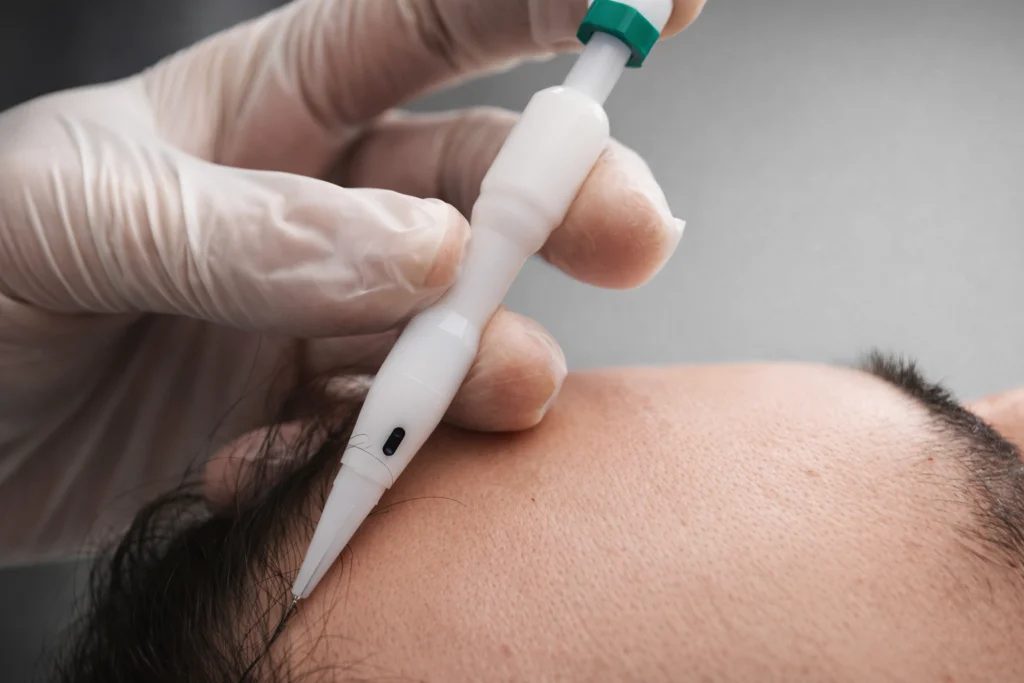
Direct FUE allows the grafts to be placed immediately after extraction, reducing the time they spend outside the body.
An implanter pen is often used, which provides precise control over the angle, depth and direction of graft placement, in order to reproduce natural growth patterns and maintain high aesthetic quality.
The results mature gradually over several months, usually between 8 and 12 months.
What should I ask during the assessment?
• What is my diagnosis and how likely is further hair loss
• How will the donor area be protected in the long term
• Who will design my hairline and who will perform the critical stages of the surgical procedure
• What is the expected duration of shedding and regrowth
• What is the long-term plan in case of further hair loss
Conclusion
Male pattern hair loss requires a long-term strategy, not an emergency response.
Identify your hair loss pattern, monitor progress objectively and set goals you can realistically maintain for at least a year.
Focus first on stabilising your current condition, maintaining a healthy scalp and setting realistic timeframes. Then consider surgery as a targeted means of reinforcing a comprehensive plan.
If you would like a discreet, medically led approach to managing your hair loss, book an appointment with Clinique de Monsieur. At Clinique de Monsieur you will receive a plan based on a personalised diagnosis, a long-term strategy to protect the donor area and a natural restoration design, which may include the Direct FUE method where appropriate, with immediate graft placement and an implanter pen for precise control of angle, depth and direction, as the results mature over the following months.