

Men looking for the best hair transplant method often come across methods such as FUE, FUT, Direct FUE and other variations, and end up feeling confused by the large number of options.
To determine which method is best for you today, your hair loss pattern, the availability of your donor area, your hairstyle preferences and the way you expect thinning to progress in the future all play an important role.
Below you will find information on each method, who it suits best and how Clinique de Monsieur approaches the choice of a hair transplant method as part of a long-term plan.
Start with your goal, not the method
What do you want to achieve from a hair transplant?
Ask yourself:
Do you want a denser hairline, more coverage in the crown area or greater overall density on top of the head for better styling?
If you first define the result you want to achieve with the hair transplant, you are less likely to choose a method based only on current trends.
Common desired results
Most men seek to achieve one of the following:
• restoring a natural hairline
• improving thinning in the crown area
• a better appearance on top of the head, allowing better styling and photos
• correcting an existing transplant
Why the hair loss pattern matters
As androgenetic alopecia progresses, the treatment plan must take likely future hair loss into account.
For example, if a lower hairline is restored without taking future hair loss into account, there is a chance of creating an unnatural-looking hairline in the future.
That is why clinicians often refer to the pattern of androgenetic alopecia when discussing long-term planning.
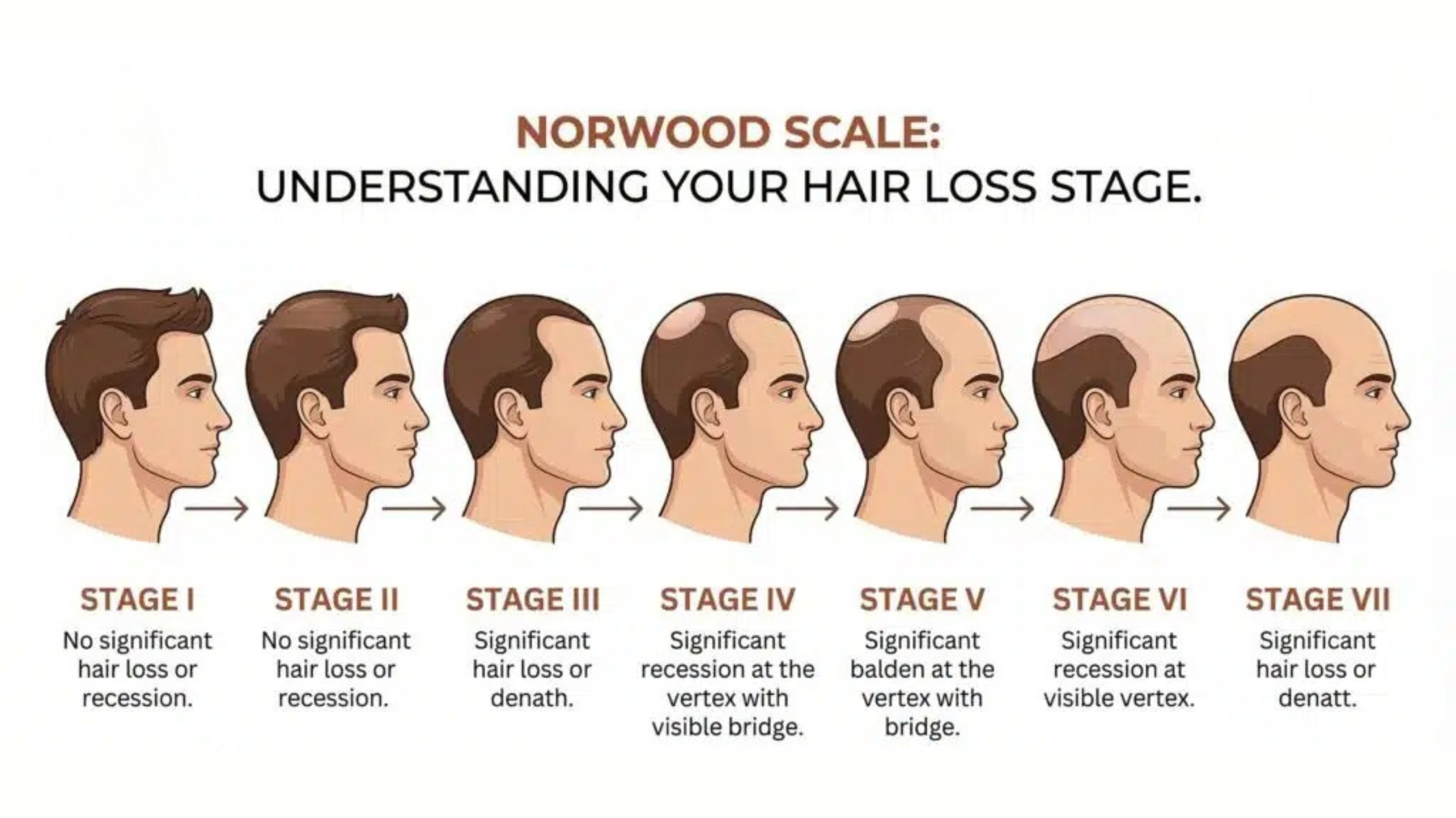
Confirm your hair loss stage and donor area before choosing a method
How can you determine your stage?
Ask yourself:
Where does the thinning appear? Mainly at the hairline, the temples, the crown or the top of the head?
Norwood scale can help you determine your hair loss stage and set realistic expectations.
In addition, you can take monthly photos of your scalp under the same lighting, so that you can track the progress of hair loss objectively instead of relying on estimates.
Why donor area management determines everything
The donor area is limited, so the best clinics make sure to preserve it.
If a clinic tells you that it can offer a very large number of grafts without explaining the limitations of the donor area, you should think carefully.
A proper plan uses the grafts efficiently, so that options remain available in the future.
FUE
What FUE is and why men choose it
A hair transplant FUE (Follicular Unit Extraction) means follicular unit extraction. In this procedure, the surgeon extracts individual grafts and then implants them in the thinning areas.
Many men choose FUE because it does not leave a linear scar and allows greater flexibility in haircuts.
Who FUE suits best
FUE is suitable if:
• you prefer to wear your hair very short and want to minimise visible scarring
• you need hairline restoration or moderate coverage of the crown
• you want a plan hair restoration in stages over time
• you want a relatively quick return to social life
Common drawbacks of FUE
FUE depends heavily on technique.
If a clinic removes grafts too aggressively, the donor area may look thin. In addition, sessions with a large number of grafts require careful planning and experienced execution.
These are reasons why ethics in hair restoration are particularly important, especially when it comes to protecting the donor area.
FUT
What FUT is and when it is a good option
A hair transplant FUT involves removing a small strip of skin from the donor area, which is then divided into grafts.
Although many men avoid FUT because it leaves a linear scar, there are cases where it is still the best option for men who need a large number of grafts and are willing to accept a scar.
Who benefits most from FUT
FUT is suitable if:
• you need a large number of grafts
• you want them placed in fewer sessions
• you plan to keep your hair long enough to cover the linear scar
Questions before choosing FUT
Ask yourself:
Will you keep your hair long enough to cover the linear scar?
How does the clinic manage closure and healing?
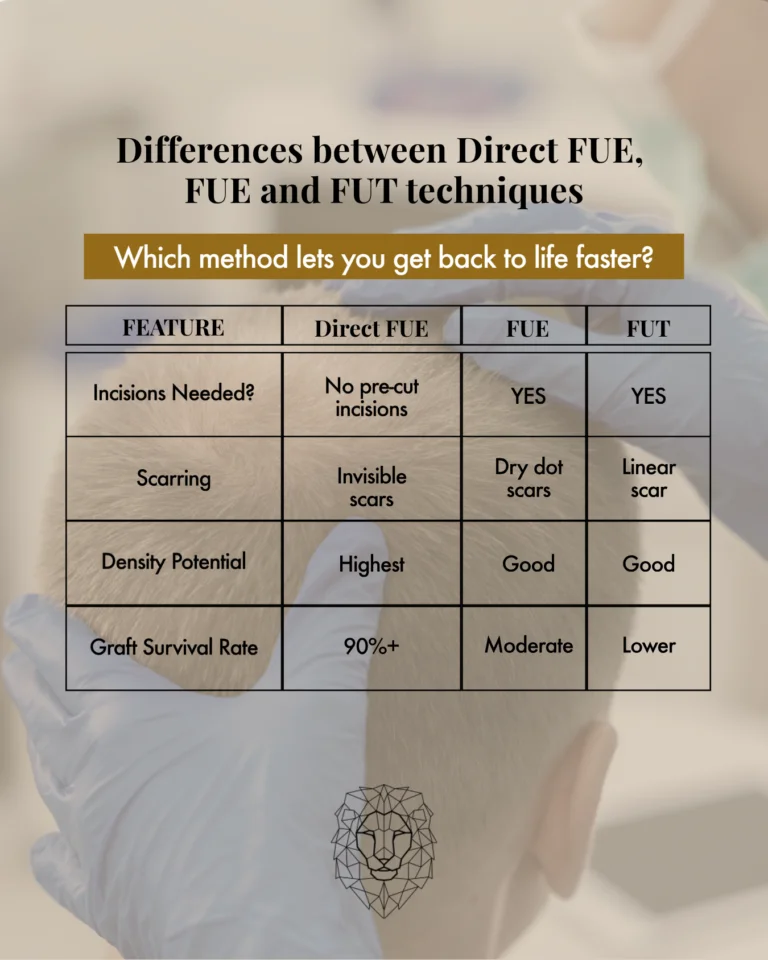
Modern variations of FUE
What Direct FUE is and why men are asking about it today
Direct FUE often refers to the process in which the graft is placed in the implantation area immediately after it is extracted from the donor area.
Many medical teams also use a tool known as a graft implanter pen, to ensure precise control over the angle, depth and direction of the graft.
As a result, many men associate Direct FUE with precise graft placement and the creation of a more natural hairline.
The technical basis of implantation methods
The technical basis of implantation methods is often discussed in the context of Hair Transplant Techniques.
Why Direct FUE is a strong option
Ask yourself:
Am I looking for the greatest possible control over hair direction and a hairline that looks as natural as possible?
If the answer is yes, Direct FUE may be a good option, especially if the clinic you choose focuses on:
• Natural angles and hairline design
• controlled placement for consistent hair direction
• an organised process with follow-up and maintenance
At Clinique de Monsieur, Direct FUE is treated as part of a long-term plan, not just a one-off procedure. This allows the results to remain natural as hair loss continues to progress over time.
How to choose the right method
Should scarring influence your decision?
Yes.
If you plan to wear your hair very short, FUE is generally considered a safer cosmetic choice.
If you plan to keep your hair longer and need a larger number of grafts, FUT may be an option.
In any case, the surgeon should discuss scarring openly and honestly.
Do I really need that many grafts?
Ask yourself:
Do I want to achieve cosmetic density or full density?
Cosmetic density is the result most men are looking for.
Hairlines are designed with an artistic approach and soft transitions, while the crown is usually restored with strategic coverage.
The maximum number of grafts is therefore not always the best plan.
Recovery time
Ask yourself how quickly you would like to return to:
• work
• exercise
• social activities
During the initial healing phase, it is normal to experience:
• redness
• small scabs
• swelling
Proper information about recovery helps set realistic expectations about the recovery time.
Conclusion
There is no single hair transplant technique that is best for all men today.
FUE is often preferred because there is no linear scar, while FUT is still suitable for men who need a large number of grafts and accept having a scar.
Direct FUE is a particularly good option for men who want precise graft placement and a natural hairline design, especially when it is part of a long-term restoration plan.
If you would like a personalised recommendation, you can schedule a consultation at Clinique de Monsieur to have your hair loss pattern and donor area assessed and the safest method for your goals selected.