

Introduction
Why is diagnosing hair loss medically important before starting treatment?
Many people treat their hair loss based on assumptions or incomplete information. However, hair loss is not a single condition. Instead, it is a symptom that can have multiple causes. Without a proper medical diagnosis, even the most modern treatments may therefore have limited effectiveness.
At Clinique de Monsieur, we stress that an accurate diagnosis is the foundation of successful hair restoration. In addition, thanks to modern techniques such as Direct FUE, the grafts are placed using the Choi implanter, offering a high degree of precision, a natural result and long-lasting durability.
This article explains how specialists diagnose hair loss, which factors are assessed and how the diagnosis affects treatment results.

What is a medical diagnosis of hair loss
What is involved in a medical diagnosis of hair loss?
A medical diagnosis of hair loss is a structured process aimed at identifying the real cause of the hair loss. The specialist examines the scalp, the hair follicles and the person's general state of health.
Why is this process so important?
Because hair loss appears differently in each person, it is essential to establish whether the cause is genetic, hormonal or temporary.
Diagnosis helps achieve key goals such as:
- Determining the type of hair loss
- Assessing its extent
- Planning a suitable treatment plan
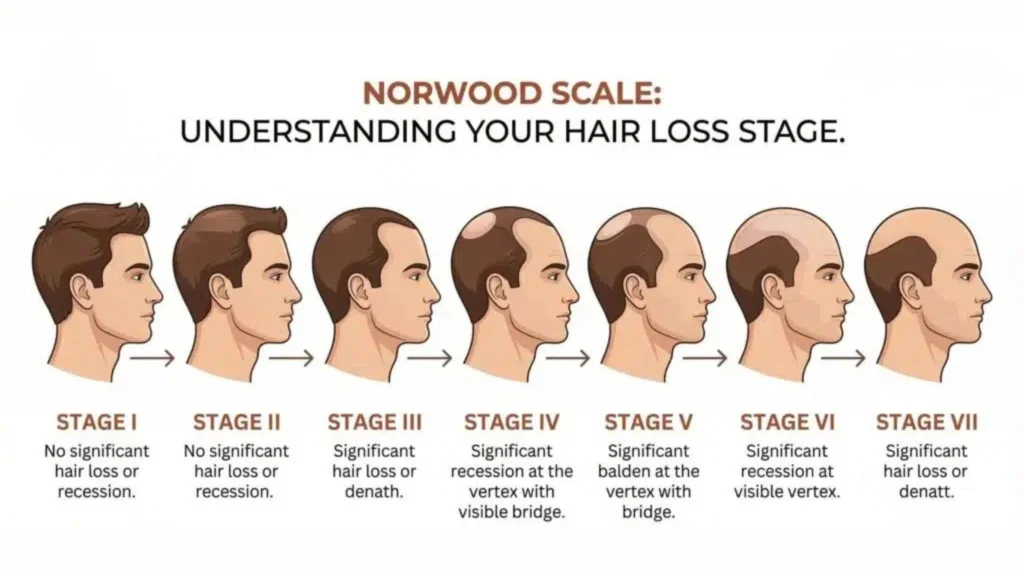
How important is a correct diagnosis
What happens when the diagnosis is wrong?
If hair loss is misdiagnosed, the treatment may be ineffective or even harmful. For example, using only topical products to treat genetic hair loss does not deliver long-term results.
How does a correct diagnosis improve results?
An accurate diagnosis ensures that the treatment targets the real cause and not just the symptoms. As a result, the treatment is more effective and its results last longer.
Benefits include:
- Avoidance of unnecessary treatments
- Lower costs in the long term
- Higher treatment success
Which causes of hair loss need to be diagnosed
What are the most common causes?
Hair loss can result from many different factors. That is why understanding the cause is decisive for treatment.
Which conditions are diagnosed most often?
- Androgenetic alopecia
- Hormonal disorders and sensitivity to DHT
- Stress-related hair loss
- Nutritional deficiencies
- Underlying conditions
Why is DHT important?
DHT plays a decisive role in genetic hair loss. It causes the follicles to shrink, leading to thinner hairs and eventually to growth stopping. This process is called miniaturisation.
How hair loss is diagnosed
What are the steps of diagnosis?
Diagnosis follows a systematic process. Specialists examine many factors for accuracy.
Clinical examination of the scalp
Doctors visually examine the scalp, the density and the pattern of hair loss.
Review of medical history
Information examined includes:
- Family history
- Previous illnesses
- Dietary habits
- Recent changes in health
Diagnostic tests
In some cases, the following are required:
- Trichoscopy
- Blood tests
What a full assessment shows
- Scalp examination
- Density measurement
- Pattern recognition
What trichoscopy is and why it matters
What is trichoscopy?
It is a non-invasive method that allows detailed analysis of the hair follicles.
Why does it matter?
It makes it possible to detect details that are not visible to the naked eye.
What can it detect?
- Follicle miniaturisation
- Hair abnormalities
- Skin conditions
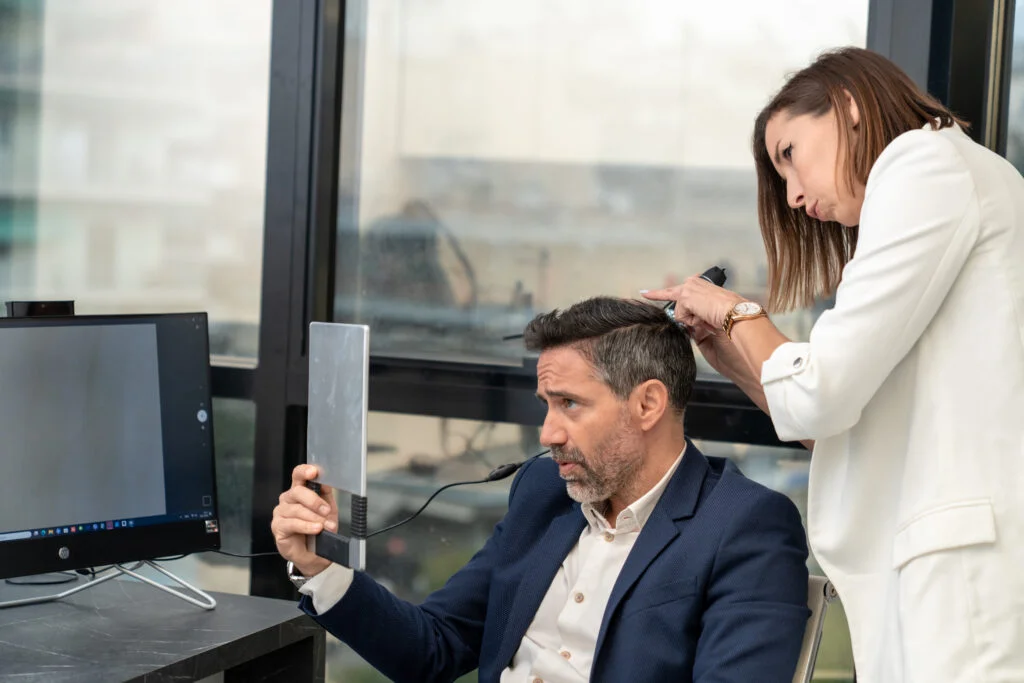
How diagnosis affects treatment
Does treatment depend on diagnosis?
Yes, absolutely. Without a diagnosis there is no proper treatment plan.
Non-invasive treatments
- Medication for DHT
- Topical treatments
They do not replace lost hair.
Transplantation with Direct FUE
In advanced stages, a transplant is performed. The grafts are placed using the Choi implanter for maximum precision and survival.
Who is suitable for a transplant
Who are the candidates?
Not every patient needs a transplant.
When is it necessary?
- Advanced hair loss
- A good donor area
- Failure of other treatments
Why Direct FUE is chosen
What makes it effective?
It offers precision and minimal trauma.
How does it improve the results?
The grafts are placed using the Choi implanter at the correct angle and direction.
Advantages
- Fast recovery
- No scars
- Natural result
The Clinique de Monsieur approach
What sets us apart?
We combine medical precision and aesthetics.
How do we personalise treatment?
- Scalp analysis
- Customized treatment planning
- Direct FUE
The grafts are placed using the Choi implanter for excellent results.
Why is personalisation important?
Every patient is unique.
Conclusion
Why is a medical diagnosis of hair loss important?
Because it identifies the cause and allows targeted treatment. Without it, treatment is based on assumptions.
In addition, the best results come from early diagnosis, proper planning and the use of advanced techniques such as Direct FUE, where the grafts are placed using the Choi implanter.
At Clinique de Monsieur, our goal is natural, long-lasting results through a personalised approach and modern technology.
Ready to discover the cause of your hair loss?
We invite you to schedule your own personalised consultation with Clinique De Monsieur.