

Why Timing Is Decisive for Hair Transplant Success
When considering a hair transplant, many patients ask: what is the best age for a hair transplant? While techniques have significantly advanced, timing remains the single most important factor in achieving natural, long-lasting results.
However, does timing affect the effectiveness of the procedure itself? Not exactly. Instead, timing determines whether your results will remain consistent, balanced, and aesthetically pleasing over time.
So when is the right moment to go ahead? And more importantly, when should you wait? Let us look at everything you need to know.

Understanding Hair Loss Progression
Does Hair Loss Happen Suddenly or Gradually?
Hair loss, especially male pattern baldness, develops gradually. It does not occur overnight. Instead, it follows a predictable pattern over time. According to the American Academy of Dermatology, most men experience progressive thinning that develops over time.
Usually
- Thinning starts in the late teens or early 20s
- The hairline recedes at the temples
- Thinning appears on the top of the head
- Eventually the condition stabilises
Therefore, understanding this progression is essential before considering a hair transplant.
Why Is Hair Loss Stability So Important?
You may wonder why not have a transplant as soon as hair loss starts.
If hair loss is ongoing, the procedure may not deliver long-lasting results. As your natural hair continues to fall out, the transplanted hair may look uneven or isolated.
Consequently, stability, not urgency, is the key to success.
What Is the Best Age for a Hair Transplant?
Is There an Ideal Age?
The best age for a hair transplant is generally considered to be between 25 and 45 years old. But why is this range ideal?
What Makes This Age Suitable?
At this stage
- Hair loss patterns are more predictable
- The donor area is stronger and denser
- The doctor can design a long-lasting natural hairline
In addition, patients in this age range show higher satisfaction rates and more stable results.
Is Age More Important Than Hair Condition?
Not necessarily. A key question is whether age alone determines candidacy.
The answer is no. A 28-year-old with stable hair loss may be an excellent candidate, while a 35-year-old with ongoing thinning may need conservative treatment first.
Stability is therefore more important than age.
Hair Transplant in Your 20s: Is It Too Early?
Can You Get a Hair Transplant in Your 20s?
Yes, but whether you should depends on your hair loss pattern.
What Are the Benefits?
- It restores a youthful hairline
- It boosts confidence at a young age
- It limits visible baldness
In addition, the more advanced Direct FUE method offers natural results even in young patients.
What Is Direct FUE and Why Is It Important?
Direct FUE is an advanced evolution of the classic FUE technique. In this method, hair follicles are extracted and implanted more directly, as grafts are being implanted with the use of a Choi implanter, reducing the time they remain outside the body.
As a result:
- Graft survival rates improve
- Healing is faster
- Results appear more natural and denser
This makes Direct FUE a preferred option for patients seeking precision and long-term quality results.
Expert Approach at Clinique de Monsieur
What Makes a Successful Hair Transplant Strategy?
At Clinique de Monsieur, success begins with a personalized approach.
How Is Each Treatment Customized?
Every patient receives:
- A tailored hairline design
- Strategically placed grafts using advanced techniques such as Direct FUE, where grafts are being implanted with the use of a Choi implanter for maximum precision
- A long-term restoration plan
What Are the Drawbacks?
However, there are important drawbacks:
- Hair loss may continue after the procedure
- You may need multiple surgeries
- Long-term hairline design is more difficult
How Can You Reduce These Risks?
To reduce the risks:
- Wait until hair loss stabilizes
- Follow medical advice
- Plan a long-term strategy
Patience can significantly improve the final result.
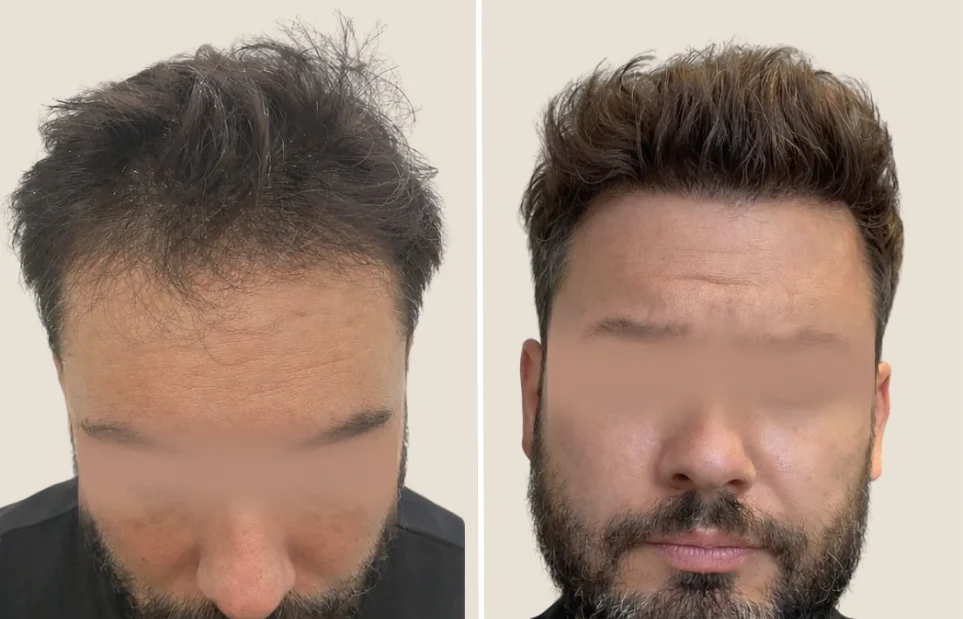
Hair Transplant in Your 30s and 40s: The Ideal Timing
Why Is It the Best Period?
Most specialists agree that your 30s and 40s are the ideal window. What makes it so effective?
What Are the Advantages?
- Hair loss progression is easier to evaluate
- The donor area remains strong
- Hairline design becomes more precise
In addition, techniques such as Direct FUE allow maximum graft survival and exceptionally natural results.
Are Fewer Sessions Needed?
Yes. Patients at this age:
- Need fewer corrective procedures
- Have more predictable results
- Achieve greater satisfaction
Is There an Upper Age Limit?
Can Someone Be Too Old?
No. There is no strict age limit. Men in their 50s, 60s and even 70s can have a transplant.
What Matters Most
- General health
- The quality of the donor area
- Realistic expectations
Are the Results Natural?
Yes, especially with modern techniques such as Direct FUE.
Factors More Important Than Age
What Makes a Good Candidate
- Stable hair loss
- A good donor area
- A healthy scalp
- Realistic expectations
Why They Matter
They affect density, survival and the final result.
What Happens If It Is Done Too Early
What Are the Risks
- Unevenness
- Ongoing hair loss
- The need for further procedures
The Clinique de Monsieur Approach
- Personalised design
- Use of Direct FUE
- A long-term plan
Conclusion
So what is the best age for a hair transplant? Although the ideal range is usually between 25 and 45, the real answer depends on the stability of hair loss, the quality of the donor area and long-term planning.
Ultimately, timing determines whether the result will look natural and remain stable over time. If you go ahead too early, complications may arise, while waiting for the right moment maximises success.
If you are considering a hair transplant, the smartest next step is expert guidance.
Book your consultation with About Us today and discover a personalised plan designed for natural, long-lasting results.